
Grassroots learning in diverse settings
A recent special issue of the journal Local Environment on the topic of grassroots modalities of learning features the work of CEI and CERN members. The special issue was edited by CEI Member Ann Hill and CERN member Justin See to show what different communities are doing at the grassroots to create and maintain conditions for their collective survival.
In the setting of Lake Budi, a biocultural hotspot in the Pacific coast of Northern Patagonia, Chile, Alison Guzman and Ignacio Krell reflect on how allied researchers can participate in grassroots learning with Indigenous peoples. In this case, the Mapuche-Lafkenche people are determining practical steps towards restoring their territory and its self-governance for kvmemongen, a Mapuche concept that refers broadly to enacting forms of living well together (for both humans and non-humans).
In the context of the Philippines, Justin See, Anne Shangrila Fuentes, Emma Porio and Brooke Wilmsen shed light on practices of intergenerational grassroots learning, especially through exchanges of information between elders/leaders and young people. The authors focus on the practice of yaru in Itbayat, Batanes (where people from different sectors of society voluntarily come together to share labour, knowledge and resources to adapt to climatic challenges), and the adaptation strategies among the residents of Tambaliza in Iloilo (where community elders share their local knowledges about their environment with young community members).
In a second paper set in the Philippines, Ana Raissa Trinidad-Lagarto, Anne Shangrila Fuentes, Justin See and Neneth Gano-Duarte focus on the experiences of the Manobo, an Indigenous group in Mindanao, and reveal how a Manobo community school operates sustainably in collaboration with other significant community actors within a politically volatile context. The authors show how grassroots learning in this Indigenous education context involves a ‘community of practice’ focused on mutual engagement, joint enterprise and shared repertoire.
School-based grassroots learning also features in the one of the papers set in the Australian context. In their contribution, Rachael Walshe, Lisa Law and Neus (Snowy) Evans explore the forms of learning that develop when gardens are a centrepiece of the school setting. They show how relational and embodied learning is fostered in ways that can help mitigate Environmental Generational Amnesia (EGA), a type of environmental forgetting brought about by prolonged disconnection from natural ecosystems and landscapes.
The second paper set in Australia focuses on garden composting and the role that non-human compost companions play as teachers or ‘learning providers’ helping humans to develop a deep, embodied understanding of how they can reduce food waste and revitalise urban soil. Bethaney Turner, Ann Hill and Jessica Abramovic also show how grassroots learning can cultivate not just practical skills, but fundamentally new ways of relating to and caring for more-than-human worlds through the development of a composting ethics.
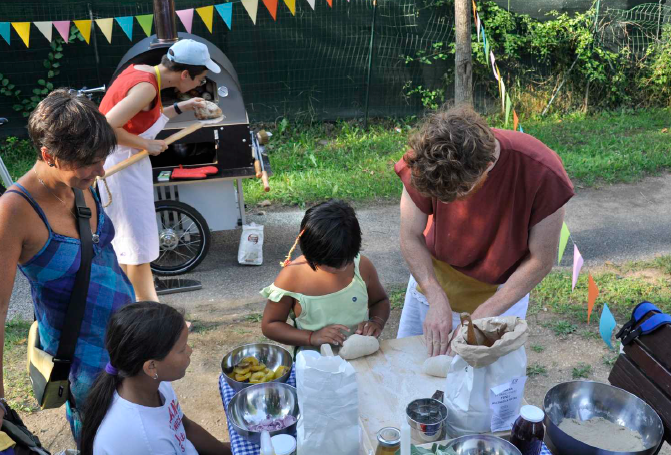 In an accompanying piece, Bianca Elzenbaumer, Flora Mammana, Carmen Gonzalez Miranda and Irene Manfrini explore what they call the ‘eco-social infrastructuring’ that supports grassroots learning projects centred on food practices. They use the term infrastructuring to draw attention to the collective co-creation of spaces, everyday practices, organisational forms, relations of mutuality and much more, that support eco-social transformations. Their piece is based on their involvement in the community academy La Foresta, based in the Italian Alps, and four projects: a community garden, a participatory drinks initiative, a mobile bread oven and a forest school.
Taken together, the five papers in the special issue and the accompanying piece showcase the pluriversal ways of thinking and living that emerge when place-based and culturally specific ways of knowing, being and doing are valued and worked with.
Jenny Cameron
Image Above: Breadmaking in a Public Park in Nomi (Italy). Courtesy of Fabio Franz