
Experimenting with Life in Vacant Spaces: Reflections on Assessing and Communicating Holistic Wellbeing Outcomes
Kelly Dombroski
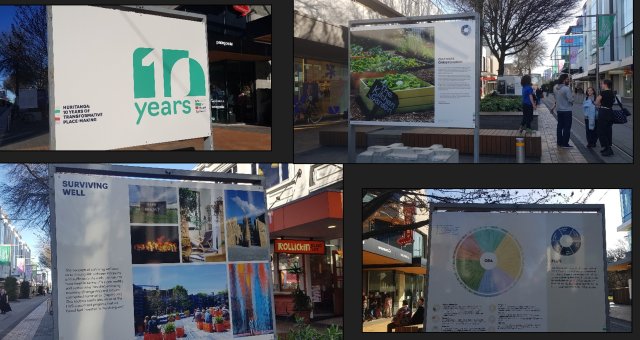
A montage of photos showing an exhibition on Cashel Street, Christchurch

In this book chapter, I reflect on several different "Community Economy Return on Investment" projects I have been involved in over the last decade. I ask how we might measuring and communicate the holistic value of community wellbeing initiatives, and narrate the experiments of trying to do so with the organisation Life in Vacant Spaces, a community organisation that facilitates temporary use of vacant spaces in Ōtautahi Christchurch in Aotearoa New Zealand.

Urban greening supported by GIS: from data collection to policy implementation

Drake, L., Ravit, B., Dikidjieva, I., and Lawson, L.

While the multiple benefits of urban greening are known, implementing green projects in post-industrial urban centers—where economic development, community revitalization and job creation are prioritized—requires accurate data that are relevant to local advocates and decision-makers. Municipal tax rolls are often used to identify vacant properties but are not necessarily up-to-date or do not contain detailed attributes about vacant properties.

Developing a Vacant Property Inventory through Productive Partnerships: A University, NGO, and Municipal Planning Collaboration in Trenton, New Jersey

Luke Drake, Beth Ravit, and Laura Lawson

This paper analyzes the development of an inventory of vacant buildings and land in Trenton, New Jersey that resulted from a research partnership between the Rutgers University Center for Urban Environmental Sustainability; Isles, Inc. a Trenton-based non-governmental organization; and the City of Trenton. Participatory research design between university and NGO staff led to a smartphone GIS survey tool that functioned through web and desktop GIS.