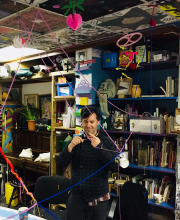
| Re-sensing economies: Artistic and embodied knowing for more-than-capitalist futures The climate catastrophe and transgression of planetary boundaries, together with the erosion of democracy and rise of oligarchy, have intensified demands for critical reflection on capitalism. This edited collection responds to these demands, featuring contributions from scholars across the social sciences disciplines and geographical contexts. The book explores ways to rethink and retheorise capitalism through theoretical, conceptual, and empirical contributions. Some contributions propose ways to reform capitalism, some emphasise the need to examine it as part of diverse more-than-capitalist economic arrangements, while others invite us to reflect on what might come after capitalism. Embracing a pluralist approach, the book reflects the dynamism of capitalism and presents diverse theoretical approaches and methodologies. Retheorising, on the pages of this book, takes the form of reconceptualising, reimagining, representing, as well as repairing. From text-based analyses to visual collaging and pottery making, the chapters engage with capitalism in multifaceted ways and invite readers to also reflect on how we sense and experience socioeconomic formations through scholarly endeavours. Through its pluralist approach, the book urges readers to explore and trouble the multifaceted workings of capitalism and engage with the possibilities for its transformation or transgression. |
| Spontaneity and the prefigurative feel When talking about prefiguration what is often talked about is the creation of formal anti-oppression protocols, sometimes critiqued as the self-bureaucratization of anarchist social movements. The result is what I refer to as the protocolization of daily life, a situation where the day-to-day is formalized into defined rules or norms. In doing so, activists often reproduce the control found at the heart of mainstream organizational forms. Such control often works to the detriment of the democratizing goals of social movements, excluding minorities and working-class people, generating the often-critiqued homogenization of social movements. This paper explores an antonym of such protocolization, what I refer to as the prefigurative feel. I will define prefigurative feel as a concern with the nature of the relationships between the people inhabiting such projects, the way they relate to each other, to time and to space. In the paper I relate this feel to an antonym of control – spontaneity. My own personal experience within social movements prompted a 12-year investigation into the issues of control and spontaneity within activism. Within it, arts-based participatory research provided rich ethnographic and biographical data of two case studies, two organizational ecologies where protocolization was tempered by a concern for the feel of the alternatives created. This data prompted the explorations presented here, not about what social movements mainly do, but about what they tend to do less of, and about the possibilities such actions less taken might afford. |
| Juxtaposition, encounter and drift: transformative social innovation through culture and the arts This paper aims to tentatively explore the benefits of placing art’s knowledge-building tradition, with its capacity to disrupt and reframe, at the centre of how we look at alternative organizing and alternative economic spaces, positioning lived experience, its uncertainties intact, at the heart of researching and practicing social enterprise (SE). The paper explores indeterminacy through two case-study narratives, one of an academic arts-based research project and the other of a unique organization it encountered. It describes the way juxtaposition, encounter and drift value indeterminacy as central to generative processes, challenging the control central tomanagement and its research. It proposes that adopting an arts-based approach that challenges control can create a research instrument sensitive to similar tendencies in case studies, thus highlighting what is different and alternative about them. This responds to concerns about the diminishing centrality of SE’s democratizing ethic expressed in its scholarship, about creativity in its research and about its socially transformative potential. The practice, by SEs of an approach welcoming chance, encounter, meandering
paths and place-making with porous boundaries, proliferates transformative possibilities and is linked to democratization and participation. Though dangerously challenging to accepted notions of academic rigour, this paper proposes an unusual thought experiment tied in with lived experiences, in themselves experimental in practice. |
| Communities |