| Solidarity Cities: Confronting Racial Capitalism, Mapping Transformation Solidarity economies, characterized by diverse practices of cooperation and mutual support, have long played pivotal but largely invisible roles in fostering shared survival and envisioning alternatives to racial capitalism globally and in the United States. This book maps the thriving existence of these cooperative networks in three differently sized American cities, highlighting their commitment to cooperation, democracy, and inclusion and demonstrating the desire-and the pressing need-to establish alternative foundations for social and economic justice. Collectively authored by four social scientists, Solidarity Cities analyzes the deeply entrenched racial and economic divides from which cooperative networks emerge as they work to provide unmet basic needs, including food security, affordable housing, access to fair credit, and employment opportunities. Examining entities such as community gardens, credit unions, cooperatives, and other forms of economic solidarity, the authors highlight how relatively small yet vital interventions into public life can expand into broader movements that help bolster the overall well-being of their surrounding communities. Bringing together insights from geography, political economy, and political science with mapping and spatial analysis methodologies, surveys, and in-depth interviews, Solidarity Cities illuminates the extensive footprints of solidarity economies and the roles they play in communities. The authors show how these initiatives act as bulwarks against gentrification, exploitation, and economic exclusion, helping readers see them as part of the past, present, and future of more livable and just cities. Solidarity Cities is published by University of Minnesota Press, as part of the Diverse Economies and Livable Worlds book series. An OPEN ACCESS version of Solidarity Cities is available, click here. 
|
| Credit unions, class, race, and place in New York City Using diverse economies and relational poverty insights, we examine the place-making practices of the cooperatively owned and democratically structured financial institutions – credit unions. In the U.S., they represent the rarely recognized but widely spread local banking systems that prioritize interests of communities over profit-maximization for outside investors. Their mission to a large degree aligns with anti-poverty and anti-racist social justice struggles and with the ethics of “solidarity” economy, a growing international movement. Our research begins a geographic inquiry into distinct non-capitalist place-making practices of credit unions while also acknowledging that they are a heterogeneous group themselves. In particular, we link their impact on place to commitment to community development and inclusion of low-income and minority populations which signal their resistance to racial capitalism and global finance. These practices are visible in special designations as low-income, minority, and community development institutions. We find that credit unions in the underserved communities address multiple forms of marginalization, as evident in overlapping designations, with the least amount of resources at their disposal. The non-designated credit unions, accounting for significant cooperative finance membership and resources in New York City, are mainly linked to employment and are more distant from social justice struggles. They eventually spatialize the benefits of solidarity finance in the better off neighborhoods in which their members live. At another level, however, these credit unions scale up solidarity finance and divert significant assets from capitalist circulation to social reproduction and solidarity realms. These findings emphasize the important differences between credit unions that matter for social transformation towards the solidarity economy. |
| Commoning and the politics of solidarity: Transformational responses to poverty This paper stages an encounter between Relational Poverty Theory (RPT) and the solidarity economy movement. RPT understands poverty as the dynamic product of economic exploitation, political exclusion and cultural marginalization. The solidarity economy movement can be seen as a transformative political response to these dynamics aiming to replace exploitation with cooperation, exclusion with participation and marginalisation with practices of inclusion. Globally, more than sixty solidarity economy movements are coordinating efforts, developing associative relations between cooperative economic institutions, social justice movements, and one another. While these developments are encouraging, many practitioners are concerned about the movement's future. Solidarity economy practitioners we encountered in our US-based research were concerned with the movement's vulnerability to co- optation and exploitation or (un)witting perpetuation of the very dynamics of exclusion and marginalisation it seeks to transcend. We take this as evidence of the enduring power of poverty-dynamics and testament to the incisive, critical insights of RPT. However, what remains unanswered is how the solidarity economy might succeed in its own terms? We deploy Gibson-Graham's theorization of postcapitalist politics to answer this question, charting the movement's possibilities, specifically how it works by creating and sharing spaces and monetary and non-monetary resources in pursuit of its objectives. Two organizations we encountered in our research—Stone Soup, a cooperative incubator in Worcester, Massachusetts and CERO, a commercial composting cooperative in Boston, — illustrate what Gibson-Graham name “a politics of commoning.” Both of these organisations work by sharing spatial, financial, and political resources in ways that are cooperative, participatory and inclusionary. |
| Precarious labour: Russia's other transition A major outcome of the post-socialist transition in Russian has been widespread and persistent poverty. For three decades now, the capitalist economy has consistently failed to provide stable employment forcing large populations of the post-Soviet poor, as well as the thin middle class, to secure livelihoods through various forms of precarious work involving short-term, insecure, low-paid, unregulated and often off-the books employment. The case of Russia demonstrates the effects of neoliberal policies with particular clarity and may be indicative of a likely global neoliberal future unless challenged by researchers, activists, politicians, policymakers, and, as ever, people themselves. This chapter focuses on temporary labour migration that became a livelihood strategy for the large number of increasingly precarious workers and its yet to be recognized political possibilities. |
| The place of common bond: Can credit unions make place for solidarity economy? About 6,000 financial cooperatives, called credit unions, with more than 103 million members manage over $1 trillion in collective assets in the United States but are largely invisible and seen as inferior to private banks. In contrast to banks that generate profit for outside investors and do not give voice to customers, these not-for-profit institutions have a democratic governance structure and a mission to provide good services to their members. We use diverse economies and critical/feminist GIS approaches to theorize them as noncapitalist alternatives to banks and possible sites of social transformation toward a solidarity economy.
Using the case of cooperative finance in New York City, we analyze spatial patterns, characteristics, and place-making practices of credit unions with different kinds of the common bond, a principle that unites a financial community, and in relation to urban geographies of class and race. We find that credit unions provide a historically proven mechanism for collective resistance to marginalization by racial capitalism and, depending on the common bond type, make place by (1) providing financial inclusion in poor and minority neighborhoods; (2) scaling up solidarity finance through participation of middle classes; and (3) diverting assets from capitalist investment into social reproduction and livelihoods. Credit unions express the racialized wealth of their communities, however, and create spatial exclusions that pose a challenge to postcapitalist movements such as solidarity economy. These findings are applicable to other places marked by segregation and call for further inquiry into possibilities and barriers to solidarity finance. 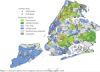
|
| Feminism, Maps and GIS Until recently, there was not much connection between feminism and cartography or GIS (geographic information science and/or system) but today they are increasingly intertwined. The meaning and purpose of mapping have significantly changed in recent decades due to several reasons. For example, the mapping process has become computerized, virtually all spatial information is now digital, and GIS has emerged as essential when working with spatial data. At the same time, women have increased their visibility and presence in science and technologies. Feminist scholarship, too, has made a profound impact on social science and geography and has come to inform and influence the fields of cartography and GIS. This article discusses the changing relationship of cartography and GIS and presents major feminist critiques of these fields. After examining the undervalued contribution of women to both cartography and GIS, the article focuses on an ongoing engagement of feminism with GIS and practices of mapping. This engagement includes reclaiming the power of vision, creating a range of feminist cartographies, and the broader impacts of geospatial technologies on women's daily lives. |
| Critical GIS as a tool for social transformation When Critical GIS emerged in the 1990s and gained momentum in the 2000s, its potential for enabling progressive social change generated considerable excitement. By combining the powers of mapping, information technologies, and critical social theory, it promised new possibilities for acting upon the growing social contradictions of the neoliberal era. Critical GIS seemed to open a pragmatic plane of action by fusing progressive geographic imaginations with concrete and tangible maps. As I reflect on the state of critical GIS in the middle of the second decade of the 21st century, new configurations of class power, patriarchy, and racism are rapidly reshaping our social and geopolitical worlds and are precipitating environmental destruction. Yet, I attempt to develop the idea that GIS is a tool for social transformation because it can produce new cartographies and spaces of possibility and build and expand geographies of hope and care that change social imaginaries in favour of non-hierarchical class, gender, and race relations. In short, critical GIS scholarship both engages ongoing progressive politics and can create new possibilities for change. In particular, I examine two interventions of critical GIS: creating cartographies of solidarity and teaching. |
| Feminism and GIS: From a Missing Object to a Mapping Subject Although feminism and the field of geographic information systems and science (GIS) have only recently begun speaking to each other, the feminist mapping subject is emerging across a variety of sites – academic, professional, and lay. However, it is most articulated in the work of critical GIS scholars. Both male and female, they are committed to nonpositivist practices of knowledge production and are sensitive to gender and other power hierarchies that produce social, economic, and cultural difference. These scholars have been creating ‘feminist cartographies’, practicing ‘feminist visualization’, and developing new mapping alternatives to mainstream cartographic and GIS representations. We begin by briefly re-reading the history of women in cartography and GIS as a first step toward reclaiming mapping as a critical practice. We then review feminist theorizations of visual representation and geography that move beyond critique and posit a feminist deployment of such technologies. Finally, we reflect on explicitly feminist engagements with cartography and GIS and their implication for the discipline of geography and contemporary mapping practices in general. Throughout, we trace the evolution of a feminist mapping subject and her or his potential to disrupt the traditions of mapping and reclaim the power of maps and GIS-based spatial analysis for critical intervention. |
| Navigating the Fault Lines: Race and Class in Philadelphia's Solidarity Economy In debates over post-capitalist politics, growing attention has been paid to the solidarity economy (SE), a framework that draws together diverse practices ranging from co-ops to community gardens. Despite proponents’ commitment to inclusion, racial and class divides suffuse the SE movement. Using qualitative fieldwork and an original SE dataset, this article examines the geospatial composition of the SE within the segregated geography of Philadelphia. We find that though the SE as a whole is widely distributed across the city, it is, with the exception of community gardens, largely absent from poor neighborhoods of color. We also identify SE clusters in racially and economically diverse border areas rather than in predominantly affluent White neighborhoods. Such findings complicate claims about the SE's emancipatory potential and underscore the need for its realignment towards people of color and the poor. We conclude with examples of how the SE might more fully address racial injustice. |
| Class Class is one of the most important, widely used, and complicated concepts in human geography and the social sciences. It underpins economic geographies and intersects with geographies of gender, race, and sexuality. Different notions of class have been in use, along the spectrum from neoclassical to Marxist economic theories. These theories have also been reworked by feminist, postcolonial, and poststructuralist scholars in order to augment critiques of class-related inequalities and to construct possibilities for imagining and producing progressive geographies of class. The contemporary global and neoliberal economy has given rise to high levels of concentration of wealth and economic insecurity that cut across the class divisions and social safety nets of the twentieth century. The politics of class remains central, however; imagining new horizons in class solidarity and transformation is as vital as ever for new and diverse class subjects. |
| Qualitative GIS In less than a decade, qualitative GIS became widely used not only in geography but across social sciences and humanities. Following critical GIS debates and feminist GIS interventions, qualitative GIS has emerged as a field that pioneered ways to map new types of data derived from qualitative interviews, historical archives, literary texts, and, more recently, social media, neogeography, and artistic visions of place. It also advanced integration of qualitative research methods with geospatial analysis in order to account for nonquantifiable, uncounted, and conceptually marginalized but important experiences and socioeconomic practices. Qualitative GIS, therefore, constructs new imaginaries of place and space that can contribute to inclusive citizenship. Advancing the fusion of this scholarship with new spatially oriented and digital research in social sciences and humanities would help to realize better this critical potential of qualitative GIS. |
| Digital Place-Making: Insights from Critical Cartography and GIS History, including contemporary history, is as much about time as it is about space, place, and territory. Not accidentally, historians have long used paper maps as their data (maps made at different time periods) and as a form of analysis (e.g., historical atlases, maps of historic battles, etc.). Maps have always been an incredibly succinct and visually powerful way to tell a story. On the one hand, therefore, turning to digital mapping technologies is continuous with this tradition. On the other hand, geospatial technologies created new ways of analyzing and representing by connecting digital maps to data behind the map. In this way, they open new opportunities and pose new challenges to historians and other humanities scholars who engage with place and space on the crest of “spatial turn” and digital revolution. Geographers working in the fields of critical cartography and critical GIS have addressed these opportunities and challenges in a number of ways. This chapter will address some of these challenges and opportunities in relation to historical and contemporary mapping practices that contribute significantly to digital place-making, and include but are not limited to the web-based and neogeographical representations of place. In particular, how can digital place-making be understood in the context of such issues as maps as a medium of power, ontological power of maps and digital representations of place, authorship of maps, what gets to be represented and what is silenced, and what kind of information is conveyed and which is excluded? What are the implications of digital divide for digital place-making and online citizenship? I will examine the above questions drawing on a combination of critical social theory, feminism, post-structuralism, and postcolonial thought. |
| Mapping Urban Change and Changing GIS: Other Views of Economic Restructuring This article discusses the use of GIS for an alternative analysis of the transition to capitalism in Moscow, Russia in the 1990s. Following the argument for incorporating quantitative methods into feminist research agendas, the article illustrates how GIS can be part of a critical and feminist analysis of economic transition. |
| Other Transitions: Multiple Economies of Moscow Households in the 1990s This article examines survival strategies of urban households in post-socialist cities during the transition from the Soviet system to a market economy. The article links the outcomes of systemic transformation to the daily lives of households and connects urban change induced by mass privatization to class and gender processes inside the households. These other transitions in everyday class and gender processes are consistently overlooked by macroeconomic approaches that dominate among transition theorists and policy consultants. |