

Steps for Building a Community Enterprise
The first step toward building community enterprises is to begin to ask the following questions:
- What are the assets of our community that could be mobilized by enterprise development?
- What needs in our community could be met through enterprise development?
- What diverse economic practices could be redirected to support enterprise development?
- Who is interested in putting volunteer time and energy into research and development of an enterprise idea?
Many ideas for enterprises might arise. It is useful to brainstorm as many as possible, including wild ideas and very ordinary ideas. It is only in the process of research and development that these ideas will be tested to see which ones can be made real.
Encourage a group of interested people to form an enterprise research and development group. These people will need to meet regularly to discuss how to see if a particular enterprise idea is going to "have legs" and come into being. This group will need to be committed enough to offer their volunteer labor to the enterprise development process.
Conducting a Feasibility Study
People will gravitate to the ideas they are most interested in. They may need encouragement to think that they can organize a feasibility study.
A feasibility study involves talking to people, asking hard questions, searching for assistance, applying rational thinking and not losing sight of the vision that communities can become entrepreneurs. It is best if the feasibility study is undertaken by those who are interested in participating in the community enterprise. Doing the feasibility study together gives people the opportunity to see how they can work alongside each other.
Elements of a feasibility study:
- Visits to similar enterprises in the wider region to "see how they do it"
- Interviews with local suppliers of raw materials to investigate volume of supply, seasonality, prices and price fluctuations, quality issues
- Research into potential markets, e.g. interviewing stall holders in the local market, interviewing other businesses who might buy the product, interviewing consumers directly
- Research the technical production and packaging requirements
- Find out about government health regulations
- Look into different organizational structures for the enterprise and their legal requirements
- Discuss possible ownership and governance structures
- Discuss different options for raising initial capital to get started
All this information can then be compiled into a Business Plan. The 'business feasibility' powerpoint presentation in the file download section below shows how the Linamon Community Partnering team approached the business feasibility study.

Workshop whiteboard with elements of a business plan
______________________________________________________________________________________
Enterprise Experiments and Business Plans
The text books advise that business plans are a necessary ingredient of enterprise development. The crucial question is when to focus on a business plan? If an enterprise development group has just formed and is needing to figure out how to work together it may be better to start experimenting with an enterprise first and leave the business plan until there is more confidence that the group can get along.
If too much time is spent on abstract business plans and not enough on concrete doing, people may get discouraged and lose interest. Often business plans get bogged down in matters of financing—how can start-up capital be raised? how can on-going financing be arranged? etc. But in practice many community businesses can begin with very little capital as people are willing to put their savings and sweat into the project to see if it might take off. As one social entrepreneur put it, for any kind of business to work there must be "skin in the game". If community members feel that some of their skin is in the business it is more likely to succeed.
A community enterprise business plan
While experimentation and voluntary labor is fine for the initial stages of enterprise development, sooner or later a business viability plan must be made and this is when the group might need to focus on important commercial issues as well as community benefits. The Community Enterprise Planning and Monitoring framework (file download below) developed by John Pearce might help to organize thoughts.
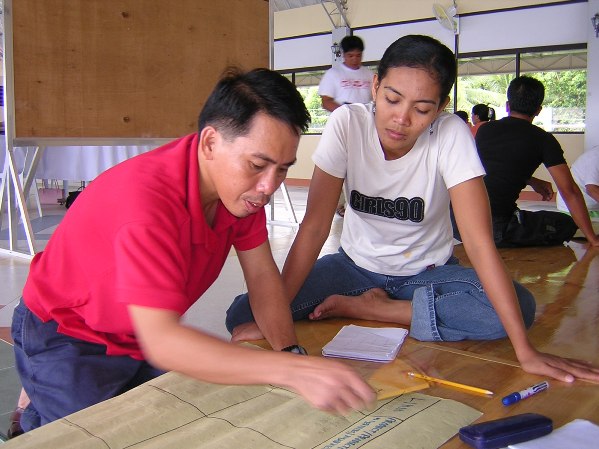
Community researchers working on business planning
______________________________________________________________________________________
Enrolling Support
As the enterprise starts to take shape there will be many areas of expertise that can be drawn on for support. These may include:
- Organizational development
- Legal
- Technical
- Financial
- Marketing
- Site management
- Moral
- Conflict resolution
- Problem-solving
Some of this expertise might be available locally—in the local government offices, in NGOs, in community organizations, in family support networks. There are also the resources of the province or region to be drawn upon. International support can also be accessed via the internet and aid organizations.
Try to build up a network of wise people whose counsel can be sought at various stages of the enterprise development journey. This powerpoint presentation available for download below shows how the Linamon Community Partnering team enrolled supporters.
The case of migrant remittance funds
Migrant workers from the Philippines come home for a vacation month during their contracts. They are often interested in becoming partners for local development. Remittance funds could be an important source of capital for community based social enterprises. What these families of migrant workers are looking for are initiatives to invest in. One goal of Community Partnering is to generate such initiatives and create partnerships between absent and present community members.
Reflection and Evaluation
A community enterprise is an ambitious undertaking. It tries to:
- solve social and environmental problems
- engage with markets
- cover costs
- make a profit that can be used for community ends
A process of regular reflection on these objectives will help to identify how the enterprise is going. In the early stages it may not be feasible to achieve all of these objectives. But it is important to evaluate each in turn so that decisions can be made about future courses of action. If only a few objectives are being met at any one time, the sustainability of the enterprise might be threatened. The Social Audit Check List (download below) is a useful tool for evaluating where the enterprise is up to in achieving its goals. It can also be used to make future plans for realizing social and environmental, as well as business goals.
To grow or not to grow?
Many community based enterprises are under pressure to scale up. This is usually interpreted as growing bigger. But there are many different ways of scaling up. See the set of Discussion Questions about Scaling Up Community Based Enterprises (download below) and use them to help clarify your particular development pathway.