

Conducting Research with Community Members
The Community Researchers are an important link to various groups in the community. Initially it is these groups that are drawn into the action research process. As the process unfolds Community Researchers reach out beyond their immediate networks to link up with other people who may be able to contribute time or expertise.
Working with the wider community involves:
- information sessions to explain Community Partnering
- small group discussion and interviews
- community brainstorms
- working with existing networks
- supporting enterprise development
______________________________________________________________________________________
Information Sessions
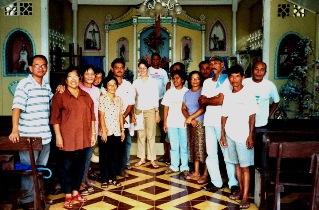
The wider community can only be drawn into Community Partnering if they understand what it is all about. Community Researchers can set up information sessions:
- in different geographical locations to access a range of place-based communities
- at meetings of already existing groups with special interests
At these meetings the idea of needs versus assets can be broached in a general way. It is often quite hard to get groups to move away from talking about needs and problems and start to think about their assets. At public meetings watch out for gate-keepers who might resist moving to the assets discussion. At the same time watch out for people who seem to get the idea and are excited about building on already existing assets. They are the people you might be able to work more with.
______________________________________________________________________________________
As Community Partnering proceeds, hold regular information sessions to let people know what is happening. Invite people to join in and contribute at any stage of the process.
______________________________________________________________________________________
Interviews and Small Group Discussions
As Community Researchers begin to identify people who might be interested in Community Partnering for Local Development they will need to use some of the ABCD-DEF research tools. They may gather together a small group for interviews and discussion or conduct one-to-one interviews with possible participants.
Small group discussion
People who are unused to being the subject of research are often more comfortable in small groups when being asked questions. In an action research project it is good for people to hear about the experience of others. The Portrait of Gifts exercise is best conducted in a small group. In pairs people can interview each other and share what they have found out with the whole group. People begin to see the gifts of their fellow community members and revalue their contributions.
Snowball interviewing
This method involves finding people to interview by tracing networks. A Community Researcher might start with someone they know well. Each person interviewed then recommends others they know who might be interested to be interviewed. The group of interviewees grows like a snowball.
This may be a good way of finding out who could be interested in joining an enterprise feasibility group.
______________________________________________________________________________________
Community Brainstorms
A series of community brainstorms is the best way to generate ideas about how to mobilize the assets at hand. At these events it is useful to display results of the Assets and Needs Mapping and Local Economic Inventory. Using a mix of visual and written materials will reach the widest audience.
Either in a large group, or in smaller breakout groups ask participants to brainstorm ideas for building on local assets. Community Researchers should be ready to take down all the ideas generated. At the conclusion of the brainstorm, community members are invited to identify which ideas they would like to prioritize. The pros and cons of each idea may be debated.
______________________________________________________________________________________
Working With Existing Networks
A bank of ideas will have been generated by the community brainstorming. The next task for Community researchers is to find people who might be interested in mobilizing to make these ideas a reality.
In any community there will be pre-existing groups to work with. They may have been formed as a support network or as a social club.
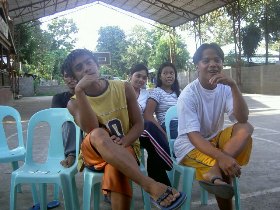
This group of out of work youth in coastal Linamon had already organized drama performances. They had experimented with T-Shirt making and were interested in exploring new opportunities for income generation. They were an ideal group for the Community Researchers to work with. They conducted assets mappoing and formed an enterprise development group to experiment with making virgin coconut oil.
This group of women all reside in upland Linamon. They are all mothers and farmers and were interested in increasing their family well-being.
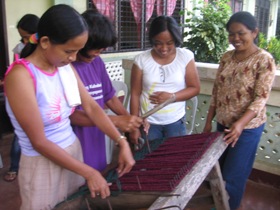
Community Researchers worked with this geographically connected group to see if they could generate enterprise ideas. They decided to use the local abundance of coconut coir to make mats and handicrafts. This process allowed them to work at home while looking after their children.
______________________________________________________________________________________
Supporting Enterprise Development
Community Researchers can facilitate the enterprise development phase by joining one of the enterprise feasibility teams or keeping close contact with a self-led team.
They can help to design and organize the feasibility study activities. Community Researchers will have the benefit of having seen other community enterprises in operation and this might assist them in directing the group.
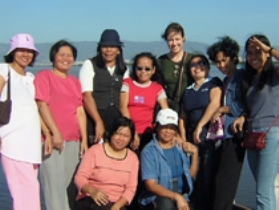
Community researchers helped to organize a field trip for this group of women from Jagna who were interested in using their dress-making skills to form a community enterprise. They travelled to Cebu City to visit a social enterprise and on the way formed close connections with each other. Their confidence grew as they saw other women like them working in their own business.
Help with problem-solving is one of the main ways that Community Researchers can provide on-going support for enterprise development. This may involve seeking assistance from institutional partners at particular times, or helping with conflict resolution at others. The Community Researcher can prompt creative, lateral thinking that will allow the group to navigate around obstacles.