

Diverse Economies Framework (DEF)
The diverse economies framework is one way of expanding our understanding of what makes up the economy.
It is organized into three columns: TRANSACTIONS, LABOR, ENTERPRISE.
Mainstream economic analysis focuses on formal market transactions, paid labor (waged and salaried) and capitalist enterprise. These activities are, however, only the tip of the economic iceberg. They are located in the top row of the DEF.
In each column below are all the other transactions, forms of labor and enterprises organized along different lines and according to alternative rules that make up the Diverse Economy.
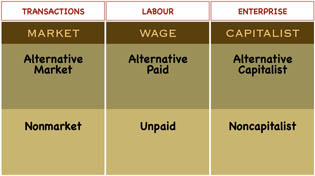
J.K. Gibson-Graham (2006, 71)
The diverse economy of each place will be different. This DEF helps you to identify all the economic assets of your local economy.
Let's look in turn at the kind of activities that you might find in each column of the DEF.
______________________________________________________________________________________
Transactions
______________________________________________________________________________________
Trade of goods and services in diverse markets
Only some goods and services are freely traded at prices set according to unregulated 'laws' of supply and demand. Many are traded in markets where prices are influenced by various power relationships. We can think of diverse markets, including:
- naturally protected markets
- artificially protected markets
- monopolized markets
- state regulated markets
- niche markets
Exchange of goods and services in alternative markets
Many of the goods and services that we rely on are obtained via exchanges in non-typical or alternative markets, such as:
- informal markets
- barter
- ethical fair-trade markets
- underground markets
- local trading system, alternative currencies
- co-op exchanges
- alternative credit
- sale of public goods
Transactions that take place outside of markets
Some of the most important goods and services are given, taken or exchanged outside of markets in areas of life often seen as 'not economic'. Yet these transactions provide material sustenance and contribute to levels of economic well-being. Non-market transactions include:
- household flows
- gift-giving
- indigenous exchange
- state allocations, state appropriations
- gleaning, poaching
- hunting, fishing, gathering
- theft
______________________________________________________________________________________
A Diverse Transactions Inventory Exercise
Based on your local knowledge, use the DEF TRANSACTIONS column to identify:
- What kinds of goods and services are traded in your local area?
- What kinds of markets exist for these commodities?
- Are there alternative markets?
- What kinds of goods and services are exchanged in non-market ways?
- What kinds of ethics govern all these different transactions?
- How many buyers or sellers are there in each market?
- What kind of power is wielded by buyers or sellers?
- Can new entrants easily enter the market or are there constraints?
- Are some goods bartered, gifted, gleaned, poached, stolen?
- What kinds of relationships exist between producers and sellers, consumers and sellers, givers and receivers?
Use this information to identify the assets and strengths of the local economy that could be built on.
Click here to download a blank Diverse TRANSACTIONS Inventory Sheet.
______________________________________________________________________________________
Labor
______________________________________________________________________________________
Paid wage labor
Most people work for a wage because they have no other way of gaining access to money with which to buy commodities and survive. Pay packets vary according to the kind of wage labor performed and degree of organization of the work force. In general, employers set the wage level. Diverse forms of wage labor include:
- salaried labor
- unionized labor
- non-unionized labor
- seasonal labor
- family labor
- part-time labor
Alternatively paid labor
There are many other ways that labor is paid for working apart from the wage contract between employer and employee. Here are some alternative kinds of paid labor:
- self-employed workers pay themselves a wage (often below subsistence)
- workers in cooperatives collectively agree on their wage payments
- reciprocal labor exchange involves a trust based agreement
- labor can be paid in kind
- indentured laborers sign up to a period of unfree labor
- work for welfare involves working in exchange for a dole payment
Unpaid labor
Much of the work that sustains the lives of families and communities is unpaid for. This does not make it less important to the economy. This unpaid labor makes a crucial contribution to material, social and spiritual well-being. Unpaid labor takes the form of:
- housework
- family care
- neighborhood work
- volunteering
- self-provisioning
- slave labor
______________________________________________________________________________________
A Diverse Labor Practices Inventory Exercise
Based on your local knowledge use the DEF LABOR column to identify the diverse labor practices performed in your community.
- What kinds of waged labor do people do? In what sectors (agriculture, trade, construction, manufacturing etc)?
- What other kinds of labor is done for payment (either in cash or kind)? In what sectors is this kind of work done?
- Are there any reciprocal labor practices? How are they organized? How common are they and how many people participate in the exchange?
- How many people in your community have left to work abroad on contracts? How often do they return?
- What other kinds of work is performed in households, family networks and communities?
- Who does what (men, women, children, elderly, middle aged, young)?
Look at the list of work practices and estimate how many people do each kind of work. Note that many people do many different kinds of work in one day or over one week. Which work is the most enjoyable and rewarding? What work practices might be seen as an asset in your local community/ How could these work practices be used for local development?
Click here to download a Diverse LABOR Practices Inventory Sheet.
______________________________________________________________________________________
Enterprise
______________________________________________________________________________________
Capitalist enterprise
Capitalist enterprises are privately owned. Workers in the enterprise work for a wage but have no rights over what they produce. The goods and services workers create are sold for a profit that is owned by the capitalist employer. Once all costs are met the remainder, or surplus, is privately appropriated. Capitalist enterprises can take the form of:
- family firms
- private unincorporated companies
- public companies
- multinational corporations
Alternative capitalist enterprise
In some capitalist enterprises surplus is distributed to social or environmental ends. These alternative capitalist enterprises include:
- state enterprises
- green firms
- socially responsible firms
- non-profit organizations
- producer marketing cooperatives
Non-capitalist enterprise
There are many other kinds of enterprise in which employers and employees organize the production, appropriation and distribution of surplus in different ways. Non-capitalist enterprises include ones in which surplus is appropriated and distributed:
- communally by the collective
- in kind by a feudal landowner
- independently by the self-employed producer
- forcefully by a slave owner
______________________________________________________________________________________
A Diverse Enterprises Inventory Exercise
Based on your local knowledge use the DEF Enterprise column to identify the range of different enterprises that operate in the local economy.
- First, identify the enterprises in terms of local, national or international ownership.
- Second, distinguish the enterprises in terms of their numbers of employees (small, medium and large).
- Third, identify the enterprises in terms of there sector (agriculture, manufacturing, trading, services).
- Taking each group of enterprise in turn, try to identify how enterprise profits are generated and distributed.
- Are there any non-capitalist enterprises? How might you categorize them using the DEF?
- How are the different enterprises linked into the local economy? Do they circulate any surplus generated in the local economy or does it drain away?
Click here to download a Diverse ENTERPRISES Inventory Sheet.