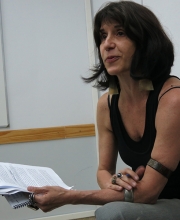
| Epistemología co(e)laborativa en organizaciones social-solidarias. Aportes desde la filosofía materialista En este texto reflexionamos sobre los aportes de los denominados materialismos a la concepción epistemológica de nuestro programa de investigación. Nos orientan las siguientes preguntas: ¿qué puntos comunes podemos identificar entre autores de las corrientes denominadas materialistas, tales que enriquecen nuestra construcción epistemológica, con efectos metodológicos y teóricos? y ¿qué aspectos de nuestro trabajo de investigación precisamos mantener abiertos, flexibles, no del todo estabilizados, si queremos profundizar en la colaboración y la co(e)laboración como metodología y epistemología? En la primera sección del texto presentamos la perspectiva socio-material a través de la obra de dos autores de referencia: Latour y Bennett. En la segunda sección realizamos una historización de los materialismos europeos. En la tercera sección desarrollamos la relación entre el posicionamiento de investigación co(e)laborativo y lo conceptualizado en las secciones anteriores. En las conclusiones hacemos explícitas las líneas de investigación futura que lo presentado en este texto nos permite indicar. |
| Terceros espacios de aprendizaje para el poscapitalismo: Lecciones de artistas, educadores y activistas Terceros espacios de aprendizaje para el poscapitalismo explora experiencias educativas que no solo cuestionan el orden establecido, sino que también crean alternativas concretas. Reúne ejemplos de escuelas, organizaciones sociales y colectivos de artistas del Norte y del Sur global a través de los cuales se analizan prácticas contrahegemónicas que amplían los horizontes de la educación formal e informal.¿ Qué obstáculos enfrentan las organizaciones y qué soluciones proponen?¿ Cómo se mantienen y construyen coaliciones dinámicas de solidaridad entre las organizaciones?¿ Qué concepciones del aprendizaje surgen allí? Este libro se inscribe dentro del campo de la política y la sociología de la educación y entabla un diálogo con las artes, las humanidades y la teoría social crítica. Su contribución radica en desplazar el foco de atención del desmantelamiento capitalista a la creatividad social que lo trasciende. Los lectores encontrarán aquí un análisis original y una invitación a pensar en la educación como un futuro posible. 
|
| Dynamic Coalitions: Organizational Solidarity in Practice |
| Cercamientos, comunalizaciones, territorios geofísicos y digital-virtuales. Una propuesta conceptual y metodológica para su análisis This article analyzes the digital field and the historical processes in which it was
privatized (enclosures), while alternatives of co-operative and solidary uses were
developed. The paper delves into the aspects related to the digital-virtual terri-
tory, proposing a literature survey that accounts for both privatization actions
and the so-called platform co-operativism (different from the privative). The no-
tions of common and communalization are introduced as distinct from those of
enclosure and accumulation, through a survey of classic critical social science
literature. Based on all this conceptual repositioning, the creation of a Popular
Memory Archive in a neighborhood of the City of Buenos Aires is described and
analyzed. Finally, we reflect on memory as a common good and its manage-
ment in digital environments. |
| Born out of Struggle in Argentina: Bachilleratos Populares with/in/against the State The economic implosion in the late 1990s in Argentina created the conditions for the emergence of a series of alternative social organizations that were autogestionados, or created from the ground up by unemployed
workers, social activists, artists, and educators. Here, we describe one of these social organizations, Bachillerato Popular IMPA, which is located within an abandoned factory that was recuperated to form a workers’ cooperative. |
| Learning and Bildung in the Work of Heydorn, Pichon-Rivière and Bleger – Connections Between Health, Critical Consciousness and Social Change |
| Weaving dynamic coalitions of strength in difficult times In December 2023 a new president took office in Argentina. Since the return of democracy after a cruel and violent dictatorship (1976-1983), Argentina has been experiencing periods of public policies oriented towards securing access to basic rights, and periods of public policies oriented towards engrossing the already big fortunes of people who exploit other beings (humans and earthbeings). However, and even if there might be differences in orientation across these perspectives, one must acknowledge that ever since 1974, Argentina started to become a neoliberal nation-state, meaning that the differences in the distribution of income and surplus became more and more obscene. The years of the dictatorship consolidated an economic policy geared towards privatizing public services and engrossing the foreign acquired debt. This became more and more difficult over time. Therefore, the president now in office continues to deepen aspects that have already been in place for decades. This may be a controversial point to be made, since the political debate in Argentina is usually positioned as if there were very different projects at place, but looking at facts over time, it is fairly easy to make visible that people who benefit from other peoples and other beings are making it more and more difficult for others to survive well. |
| Inclusión sociolaboral en clave de salud mental comunitaria: una perspectiva geográfica En este artículo analizamos las situaciones de acceso al lugar de emplazamiento actual de varios grupos pre-cooperativos que encuadran en la denominación de “cooperativas sociales” que se nuclean en un entramado más amplio, el de una Asociación Civil denominada Integración Comunitaria por la Salud Mental Una Movida de Locos (MdL), situada en la Ciudad de La Plata, Provincia de Buenos Aires, Argentina. En este texto proponemos
responder a la siguiente pregunta general: ¿Qué aporta una perspectiva geográfica a la comprensión de prácticas de salud mental comunitaria? Para responderla, ponemos en diálogo la perspectiva geográfica feminista de las economías comunitarias y la diversidad económica con los aportes de la salud mental comunitaria. Hemos generado los datos co(e)laborativamente entre dos equipos de trabajo que venimos investigando juntos y sostenemos una labor de documentación etnográfica colaborativa. Trabajamos identificando lugares, aspectos socio-espaciales y territoriales, a través de tres pasos analíticos (descripción, análisis socioespacial e interpretación territorial) que tienen su inspiración en la geografía y en su cruce con nuestro campo de trabajo (salud mental comunitaria). Al realizar el análisis sobre el lugar, apelaremos también a comprender cómo es entendido el espacio por parte de quienes participan de las experiencias, y qué marcas reconocen ellos mismos de dicha espacialidad en su producción de subjetividad colectiva actual. En tanto en este momento, estas agrupaciones pre-cooperativas están iniciando un proceso de asociación entre ellas para constituir una cooperativa de trabajo que las aloje y formalice a través de esa forma jurídica, resulta relevante preguntarnos sobre los efectos del espacio en la conformación de este nuevo proyecto. También -y a través del concepto de territorio- presentaremos una elaboración sobre las relaciones de sinergia y tensión de esta experiencia, tanto en lo referente al espacio como a la formalización como cooperativa, en su proceso de lucha y transformación.
In this article we analyze the situations of access to the current location of several pre-cooperative groups that fall under the denomination of "social cooperatives" which are grouped in a broader framework, that of a Civil Association Integración Comunitaria por la Salud Mental Una Movida de Locos "MdL", located in the city of La Plata, Province of Buenos Aires, Argentina. In this text we propose to answer the following general question: What does a geographical perspective contribute to the understanding of community mental health practices? To answer it, we put in dialogue the feminist geographic perspective of community economies and economic diversity with the contributions of community mental health. We have generated the data collaboratively between two teams that have been researching together and are engaged in collaborative ethnographic documentation. We work identifying places, socio-spatial and territorial aspects, through three analytical steps (description, socio-spatial analysis and territorial interpretation) that are inspired by geography and its intersection with our field of work (community mental health).When analyzing the place, we will also appeal to understand how the space is understood by those who participate in the experiences, and what marks they themselves recognize of this spatiality in their current production of collective subjectivity. As these pre-cooperative groups are currently initiating a process of association among themselves to constitute a work cooperative that will house them and formalize their previous processes through this legal form, it is relevant to ask ourselves about the effects of space in the conformation of this new project. Also -and through the concept of territory- we will present an elaboration on the relations of synergy and tension of this experience, both in terms of space and formalization as a cooperative, in its process of struggle and transformation. |
| Autogestión pedagógica en la universidad |
| Social and solidarity economy and self-management Social and solidarity-oriented and self-governed processes of organizing economic life have existed since humans have collaborated to survive. However, the conscious demand and conceptual realization of the social aspects of the economy only arose in Western thought with the emergence of a primarily market-based exploitative economy and the enclosed commons, forcing working people into capitalism’s system of production and exchange (McMurtry, 2010; Polanyi, 2001 [1944]). This chapter first reviews the most cited definitions of what is increasingly termed the social and solidarity economy (SSE), related concepts, and their contextual and theoretical perspectives. Secondly, we present four dimensions of the SSE as entry points for discussing and summarizing its most salient components, taking up both concepts and practices developed over time and across geographies. Throughout, we also remain sensitive to trans-cultural and cross-linguistic practices and ways-of-knowing in regard to non-Western social and solidary economics, which remain mostly inaccessible to mainstream and mostly Western SSE debates. Finally, we offer summative thoughts on the continued promises and potential of the SSE and why the work of conceptualizing and visibilizing it is important in the search for other ways of “doing economy” (Gibson-Graham and Dombroski, 2020, p. 1). |
| Communities |
| Community Economics and the Social and Solidarity Economy Community Economies (CE) is a key term in the growing interdisciplinary subfield of diverse economies (DE) scholarship, a perspective that continually grew from the pioneering feminist political economy and economic geography scholarship of J.K. Gibson-Graham (2006). It defines ‘community’ as a space where humans negotiate the terms of our shared coexistence and in which ‘solidarity’ is one possible disposition. CE and DE may offer Social and Solidarity Economies (SSEs) three important contributions: 1) an open and pluralist concept of both economy and community where humans negotiate the terms of our interdependence; 2) an appreciation for how these negotiations respond to different conditions and places producing different SSEs; 3) an argument for the necessity of extending solidarity that aligns with the cosmologies of many peoples, but has been only recently acknowledged in academic disciplines in depth. |
| Prólogo en el libro Inclusiones y cooperación social en salud mental. Narrativas en primeras personas del plural |
| Diversidad económica y economías comunitarias Reseña del libro: Casellas Antònia. J.K. Gibson-Graham: Hacia una economía postcapitalista o cómo retomar el control de lo cotidiano. 2022. España. Icaria Editorial |
| Acciones emancipadoras hacia transiciones más justas: Métodos para identificar y analizar el valor generado en común y para el bien común Diferentes grupos, movimientos y coaliciones generan prácticas que buscan transformar las estructuras económicas, sociales y culturales tal como hoy las conocemos y, al hacerlo, amplían el acceso a derechos. Estas acciones suelen ser consideradas por esos mismos colectivos como acciones emancipatorias hacia transiciones más justas. |
| Procesos de subjetivación y aprendizaje cooperativo The processes of subjectivation within a cooperative of workers in the City of Rosario, Argentina, are analyzed and interpreted in relation to literature in the fields of philosophy, economic geography, ethnographies and sociolinguistics. This text has been written by a team of 8 people (two collaborative researchers and six workers researchers). |
| Organizational solidarity in practice in Bolivia and Argentina: Building coalitions of resistance and creativity This article considers organizational solidarity in practice—modes of organizing rooted in solidarity, relationality, coalition-building, and difference. It does so by studying two Latin American illustrative cases: Bolivia’s campesino-indígena movements coalescing traditional practices and urban-neighborhood experiences in order to self-organize socio-political spaces; and Argentina’s worker-led empresas recuperadas por sus trabajadores (worker-recuperated enterprises), where workers have been drawing on working-class self-activity to convert companies to cooperatives and self-manage spaces of production. Via a diverse economies approach, the article begins to inventory, describe, and provisionally theorize the recuperations, rearticulations, and creative proposals for organizing social, cultural, and economic life being forged by these diverse groups. The article ultimately unravels four broad commonalities threading and shaping each case: the neoliberal political economic context, collective memory, horizontal organizing, and coalitional possibilities. Though emerging in different national conjunctures and histories, what these two cases bring to the surface are the resistive and creative dimensions of each organizing experience. They are rooted in deeply relational coalitions linked via solidarity in difference, while drawing on collective memories of the past to recreate and reenvision the present and the future beyond the legacies of colonial histories and capitalist-centered actualities. 
|
| Economy as Ecological Livelihood - Chapter 2 This is a translation of Chapter 2 by Gibson Graham and Miller in the book MANIFESTO PARA VIVIR EN EL ANTROPOCENO Katherine Gibson, Deborah Bird Rose, and Ruth Fincher, editors (Manifesto for living in the Anthropocene, in English).

|
| Vivir, educar y luchar en el campo. Acciones y coaliciones de pobladores rurales We analyze actions carried out by rural inhabitants in the Provinces of Chaco and Buenos Aires, Argentina, carried out to counteract the effects of the agro-industrial model. The actions we analyze may seem minor or even go unnoticed, yet they are the way in which these populations counteract hegemonic politics of death. Through analyzing what we term "semantic chains" we are able to show that the people with whom we work act, perceive and signify their relation to land, work, and life in contextually situated ways by which they defend their right to live as they choose. In order to carry out these actions, several groups cooperate, and build coalitions, even though these coalitions are not perceived as stable political structures of participation, nor are they spoken in those terms. However, due to the fact that these actions and coalitions allow them to make and take decisions, and find a way to carry out their lives as they choose, we interpret them as political in nature. Our theoretical framework is interdisciplinary and our methodology is built on a combination of ethnography, sociolinguistics and semantics. 
|
| Alternation Rural Schools and Co-management. A Sociolinguistic and Ethnographic Framework to Analyzing Decision Making at the Board |
| Self-Managed Enterprise: Worker-Recuperated Cooperatives in Argentina and Latin America This chapter discusses self-managed enterprises in Latin America with a focus on Argentina, analysing how they emerge, their implications for community economies, and their role in la econom'a de los trabajadores (the workers’ economy). The authors particularly address how empresas recuperadas por sus trabajadores (ERTs, worker-recuperated enterprises) transform capitalist and hierarchical firms into cooperative and horizontalized enterprises; how their self-managed workers rely on and further forge associated labour; and how these firms produce and share wealth rather than extracting surpluses for private gain. It is in these respects that the authors conceptualize these workers’ contributions to community economies and taking back the economy by and for workers. Further contextualizing ERTs’ contributions in the last 20 years, they finally identify three key forms of praxis threaded throughout these experiments in self-management: horizontalización (horizontalization), autogestión (self-management) and territorialización (territorialization). |
| Grupos – Teoría y técnica Este texto permite tanto a quienes recién se inician en la obra de Pichón Rivière como a quienes toman su perspectiva y ya están formados en su campo de actuación, revisitar algunos conceptos centrales de la teoría de grupos y de su relación con técnicas de intervención. Asimismo, el estudio preliminar sitúa la obra de Saidón (originalmente producida en portugués) en el campo de trabajo de la psicología social y el análisis institucional en su momento, y permite pensar asimismo la vigencia de una forma de trabajar en grupos que sostenga e intervenga, que indique modos posibles de lectura y –simultáneamente— permita modos abiertos a una nueva construcción de sentido posible. Han traducido un texto de la década de 1980, producido originalmente en portugués por Saidón, y lo complementaron con un artículo que pone dicho trabajo en perspectiva actual, realizado por Heras y Kendelman. La traducción del portugués al castellano fue también realizada por estos dos últimos autores. |
| Un análisis histórico y geográfico de la articulación de escuelas de alternancia Realizamos una reconstrucción histórica y geográfica del surgimiento y desarrollo de la pedagogía de la alternancia tal como se fue generando en diferentes continentes, centrándonos en las experiencias de Francia, Brasil y Canadá. Interpretamos la forma en que diversos actores sociales se han auto organizado en distintos países para abrir y sostener en el tiempo escuelas rurales de alternancia. Nos hemos preguntado: ¿en qué momentos y lugares se configuran procesos de auto organización comunitaria para abrir escuelas que permitan a los jóvenes de ámbitos rurales continuar con sus estudios luego de la educación primaria? ¿Qué actores sociales participan en cada caso y a qué tipos de demandas responden? Nuestros resultados muestran que la expansión de la pedagogía de la alternancia en el mundo se fue realizando a partir de contactos entre grupos que comparten una orientación similar en diferentes lugares geográficos (respeto por las formas culturales de la ruralidad, interés en construir instituciones educativas que permitan la participación de diferentes actores sociales, generación de herramientas pedagógicas distintivas). Así, esta pedagogía puede considerarse, tal como algunos de sus antecedentes lo indican, como un movimiento (inclusive de carácter internacional) conservando sin embargo el carácter singular de cada experiencia en cada historia y geografía particular. |
| Community Economy This short essay is one of 50 keyword essays published online by the Antipode Foundation to celebrate 50 years of the radical geography journal, Antipode. The essay overviews the idea of community + economy, and outlines various ways that community economies might be further activated.
The Community Economy essay can be downloaded here.
The full e-book of 50 keywords can be downloaded here.
|
| Ferenczi's theory on power and its pollination to and within Latin America |
| La Etnografía Colaborativa en la formación en investigación en Ciencias de la Educación In this work we examine the potential contributions from collaborative ethnography in Education Sciences career, putting under discussion some aspects of academic university learning. Since collaborative ethnography in education posses a debate on who produces knowledge, when, how, for what and with what tools, it allows reflection on central elements of research teaching. We review some specific characteristics of this approach and describe the presentation made to university students of the Career of Educational Sciences of the National University of Rosario, Argentina. Through a virtual device, the potential contributions of the collaborative ethnography approach in education were then discussed. This allowed us to analyze the ways in which students assumed the ideas presented and its potential use in their future research paths. From there, we conclude on the importance of its incorporation to an educational research course in the university in spite of the challenges that this entails. |
| Dislocando la propiedad. Un análisis sobre usos del espacio en una experiencia colectiva en Rosario, Argentina El capitalismo, en tanto realidad histórica, se ha fundado desde una producción del espacio basada en la creación, naturalización y legitimación de lapropiedad privada. No obstante, dicha perspectiva se encuentra en tensióncon otros modos de pensar y hacer la vida que re-significan al espacio comobien de uso común y como lugar para habitar decidiendo en conjunto. Desde una concepción teórica y metodológica situada en la perspectiva de lageografía crítica con aportes de otras disciplinas (filosofía política, historiajurídica y estudios culturales) y una metodología que combina la etnografíacolaborativa y el análisis institucional, este artículo indaga en las prácticas ysentidos acerca del uso del espacio junto a una red de organizaciones denominada ?Movimiento de Trabajadores Autogestionados? (MTA), ubicada en laciudad de Rosario (provincia de Santa Fe, Argentina). Nuestro objetivo radica en poner en visibilidad los modos en que sus participantes usan y deciden sobre el espacio para interpretar los sentidos y orientaciones que surgen dedichos modos, ya que constituyen una forma distinta a la propuesta por elmarco conceptual y de práctica capitalista |
| Nińas y nińos toman la palabra: el potencial formativo de la narración / Children find their voice. The educational potential of narration This study analyzes a pedagogical experience in Buenos Aires City developed by a staff team and a group of volunteers that work with homeless children. The goal of the study was to identify learning opportunities obtained through narration from a sociolinguistic perspective, considering multi-mediated interactions as analytical units. Methodologically, the authors examined the availability, access and transposition of different semiotic systems. The outcomes of the research show that facilitating access to a variety of resources enables individual participants to speak up and express themselves and also enables the group to express itself as a collective. The authors conclude that the pedagogical experiences of this kind clearly establish the educational potential of narration and self-expression and facilitate the description of undignified ways of living, as voiced by the homeless children that participated in the study. |
| De la personalidad autoritaria a la personalidad neoliberal Translation and response to 'From authoritarian personality to neoliberal personality' |
| Educación, autoorganización y territorio / Education, Self-organization and Territory We present an analysis of two self-organized educational experiences in Argentina that respond to concrete needs regarding the supply of education in certain geographical locations: alternative rural schools, jointly managed by families, the state, and local communities; and an educational center that is self-managed by the employees and directed to homeless teenagers and adults. We use the notion of inhabiting space as an expression of social, cultural, and aesthetic relations, contrasting this notion with that of space as an object. The analysis shows that these experiences establish innovative educational institutions, in spite of their location within current administrative rationality, through articulation with ideological and geographical neighbors over time. We conclude that the notion of territory is fertile for understanding this type of capillarity and institutional conformation. |
| Una apuesta por la vida: ética y estética en formas colectivo solidarias El artículo se inscribe en una investigación etnográica realizada en Argentina con organizacionesorientadas por la autonomía como proyecto. Desde el marco conceptual del análisis institucionaly las economías comunitarias, presenta una metodología que permite analizar prácticas,discursos y signiicados en tres experiencias autogestionarias. Analiza los modos que asumenel trabajo, la propiedad y la subjetividad en estas experiencias y concluye que: 1) su quehacerfunda una propuesta ética y estética ligada al sostenimiento y disfrute de la vida y 2) sus formasde producir la existencia interpelan los sentidos del capitalismo actual. |